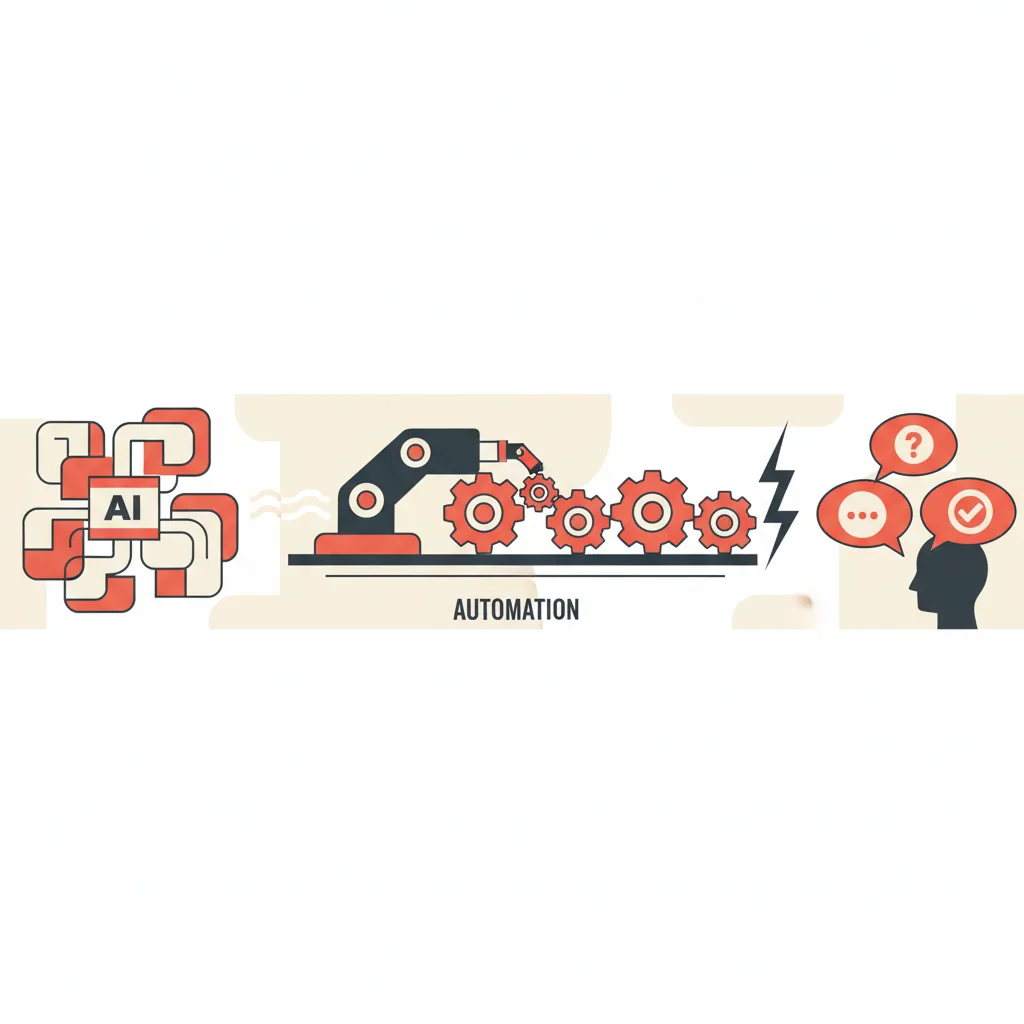
If you've taken a meeting with any software vendor in the last two years, you've heard all three of these words used interchangeably: AI, automation, and chatbots.
They are not the same thing. They solve different problems. They cost different amounts. And the reason most businesses buy the wrong one is because the salesperson didn't make the distinction clear — or didn't know it themselves.
Let's fix that.
The One-Line Summaries
Automation: Software that does a repetitive task exactly the way you told it to. No decisions, no judgment. It follows the rules.
Chatbots: Scripted conversation software. Customer says X, bot replies with Y. If the customer says something unexpected, the bot either defaults to "I don't understand" or hands off to a human.
AI (specifically, AI agents): Software that can understand intent and make decisions. It can handle messages or tasks that don't follow a predictable pattern, because it reasons about what's being asked.
All three can be useful. The question is which one fits the problem you're trying to solve.
Automation: The Workhorse
Automation is the oldest of the three. You've probably been using it for years without calling it that.
Examples of automation:
- Your email marketing tool sending a welcome email 24 hours after someone signs up
- An accounting system that generates monthly invoices on the 1st
- A Zapier workflow that posts new Shopify orders to a Slack channel
- A calendar tool that blocks out your lunch break automatically
What these have in common: the rules are clear, the steps are fixed, and nothing requires judgment.
Automation works brilliantly when:
- The task happens the same way every time
- The inputs are predictable (a form, a trigger, a date)
- There's no need to "understand" anything — just to do something
Cost: Usually cheap. Tools like Zapier, Make, and n8n cost RM100-500/month for most SME use cases. If you have an engineer, you can build automations from scratch for almost nothing.
Where it fails: The moment the task requires reading free-form text (an email, a customer message, a document) and understanding what it means, pure automation breaks. That's where AI comes in.
Chatbots: The Scripted Answer Machine
Chatbots were the hot thing in 2017-2019. Every business owner was told they needed one. Most of them bought one, built a decision tree, and watched customers get frustrated with it.
Here's how a traditional chatbot works:
- You design a conversation flow: "Hi! What can I help with? 1) Order status 2) Return an item 3) Talk to a human"
- The customer picks an option
- The bot follows the branch you designed
- If the customer types something outside your script ("where's my bloody order, I paid 3 days ago"), the bot either fails or bounces the conversation to a human
Chatbots work okay when:
- Your customers' questions are genuinely limited to 5-10 variants
- You can afford the friction of a menu-based experience
- You mainly need deflection for very simple questions (hours, location, basic FAQs)
Chatbots fail hard when:
- Customers write in Malay, English, Mandarin, or a mix (chatbots don't handle language flexibility well)
- Questions are phrased in unexpected ways
- The conversation needs to branch based on something the customer hasn't explicitly told you yet
- Customers need to feel heard, not funnelled through a flowchart
Cost: RM200-2,000/month depending on the platform. Cheap on paper, but the hidden cost is customer frustration and lost conversions when the bot fails. If you've ever rage-quit a chatbot on a company's website, you know the feeling.
The honest truth: Most chatbots deployed in 2017-2020 are still live today, still annoying customers, and still not being replaced because somebody on the team is reluctant to admit the investment was wrong. If that's you, you're not alone.
AI Agents: The Thing That Actually Understands
This is what "AI" means in 2026 when people talk about AI for business.
An AI agent isn't following a script. It's reading the actual message, understanding what the person wants, and deciding how to respond — based on what it knows about your business.
Back to the earlier example: "where's my bloody order, I paid 3 days ago."
- Automation: Doesn't work. This isn't a form. There's no rule.
- Chatbot: Says "I don't understand. Try: 'track order', 'talk to human'." Customer leaves angry.
- AI agent: Recognises the customer is frustrated, looks up their recent order by email address, checks status, replies with "Your order is out for delivery today — sorry for the delay. Here's your tracking link. Is there anything else I can help with?" In the customer's language, whether that's English, Malay, Mandarin, or Singlish.
That's the difference. It's not magic. It's the combination of:
- Understanding free-form human language
- Accessing your business data (orders, customer records, knowledge base)
- Making a reasonable decision about what to do next
Cost: RM2,000-8,000/month for most SMEs to build and run an AI agent that handles customer support or lead qualification. More if your use case is complex.
A Decision Tree for Picking the Right One
Ask these three questions in order:
1. Is the task purely rule-based?
If yes → Automation is enough. Don't pay for AI. You don't need it.
Examples:
- Generating weekly sales reports on Monday morning
- Sending a receipt email when a payment is received
- Adding new form submissions to a Google Sheet
- Posting a Slack notification when a ticket is created
If the rules are crystal clear and the inputs are predictable, automation tools are cheaper, faster, more reliable, and easier to debug than AI.
2. Does the task involve free-form text from humans?
If no → Stick with automation.
If yes → You need AI, not a chatbot.
Customer messages, emails, support tickets, social media DMs, document extraction, voice transcription — all of these involve unpredictable human-written text. Chatbots can't handle this well. AI can.
3. Does the response need to adapt based on context?
If the response depends on things like: who the customer is, what they've bought before, what your current inventory is, what the refund policy says for their specific situation, what language they're writing in — you need AI.
If the response is always the same for the same input — automation.
If the response is "read the actual question and figure it out" — AI.
Common Mistake: Paying AI Prices for an Automation Job
Some vendors will happily sell you "AI-powered workflow automation" when what you actually need is plain automation. The "AI" in the name is marketing.
A red flag: if the vendor can't explain what the AI is specifically doing that automation couldn't, they're selling you the AI label, not AI capability.
Test: ask "what happens if I give it an input it hasn't seen before?" If the answer is "it'll fail the same way a script would", it's automation with AI branding. Pay automation prices.
Common Mistake: Paying Chatbot Prices for an AI Job
The opposite also happens. A business needs AI — their customer messages are unstructured, multilingual, complex — and they buy a cheap chatbot because the price is attractive.
The chatbot fails. Customers complain. The business concludes "AI doesn't work for us" and gives up.
But they didn't try AI. They tried a chatbot.
Test: look at 20 real customer messages from last week. If more than 3 of them couldn't be handled by a rigid decision tree, you need AI, not a chatbot. A chatbot will eat those 17 messages and embarrass you.
The Cost Comparison SMEs Actually Care About
For a Malaysian or Singaporean SME handling ~500 customer messages a week:
Option A — Hire a full-time customer service rep
- Cost: RM3,000-5,000/month salary + benefits
- Handles: All messages, in the languages they speak
- Limits: 8 hours a day, 5 days a week, takes leave, gets sick
Option B — Chatbot
- Cost: RM300-1,500/month
- Handles: ~20-30% of messages (the rigidly FAQ-shaped ones)
- Limits: Customers get frustrated when they don't fit the script
Option C — Plain automation
- Cost: RM100-500/month
- Handles: 0% of free-form messages. Only handles rule-based tasks.
- Limits: Can't read messages at all.
Option D — AI agent
- Cost: RM2,000-4,000/month (setup + operation)
- Handles: 70-85% of messages, 24/7, in multiple languages
- Limits: Hands off complex/sensitive cases to humans
Option D isn't always the right answer — but for most SMEs drowning in WhatsApp messages, it's the one that actually solves the problem. It costs less than a salary, works outside business hours, and scales with volume without extra hires.
The Short Version
Automation is for rules. Chatbots are for scripts. AI is for anything that needs understanding.
If a vendor is pitching you "AI" but what they're describing is a set of if-then rules — it's automation. That's fine, but don't pay AI prices.
If a vendor is pitching you "AI" but it's really just a decision tree with nicer UX — it's a chatbot. Your customers will still rage-quit it.
If a vendor is pitching you AI and they can show you the actual messages it's handling, the decisions it's making, and the hand-off to humans on edge cases — that's the real thing. Pay accordingly, and expect real results.
Not sure which one your business needs? Book a free AI audit. We'll look at your actual workflows and tell you honestly whether AI is the right tool — or whether plain automation would save you more money.