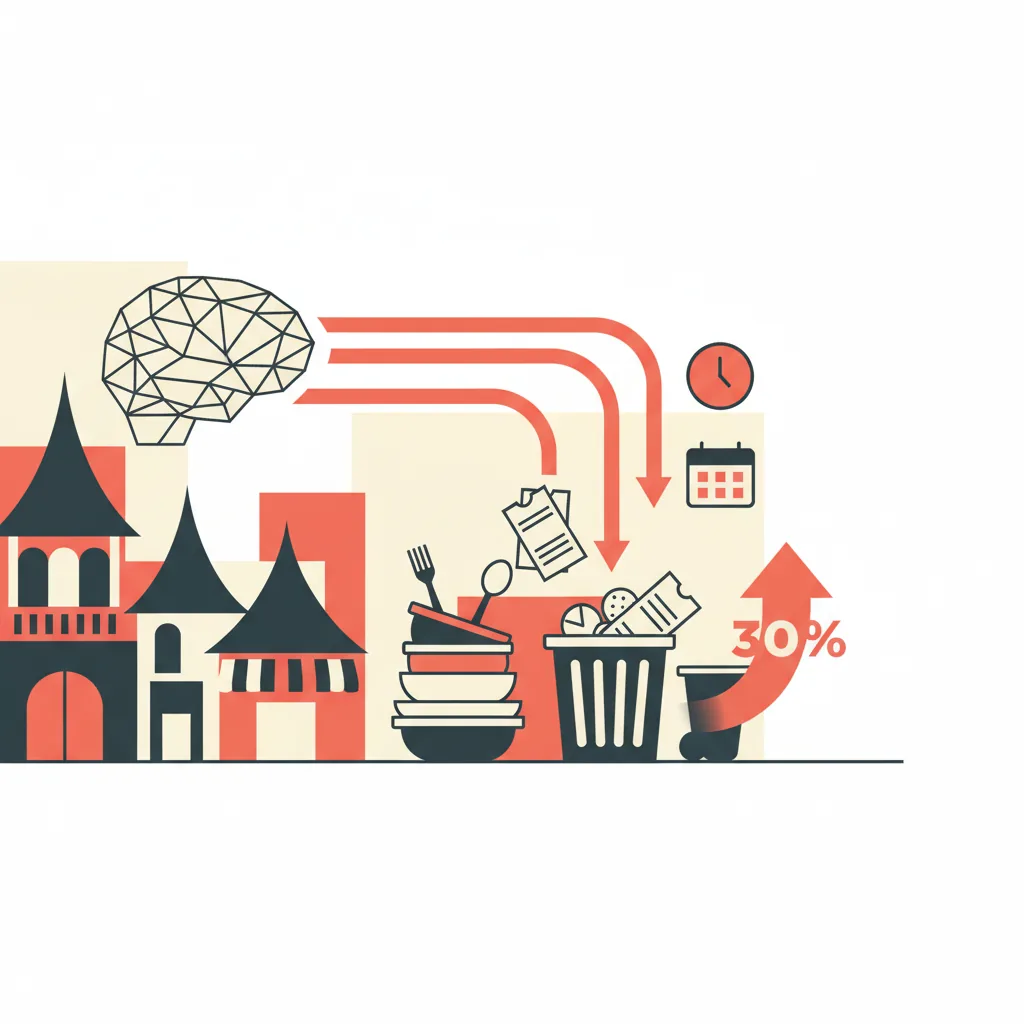
If you run a restaurant in Malaysia, you already know the math is tight.
Food costs are up. Labour costs are up. Rent is up. The margin that used to be 15-20% is now 8-12% on a good month, and any miscalculation — over-ordering fresh produce, understaffing Saturday night, missing WhatsApp enquiries — eats the rest.
A quiet shift has been happening in the KL and Singapore restaurant scene over the last 18 months. Operators who adopted AI early are reporting numbers that used to sound impossible: food waste down 25-35%, response time on customer DMs under 30 seconds, reservation no-shows cut in half.
None of this is magic. It's a few specific AI applications, applied carefully, to the exact problems that drain F&B margins.
Here's what's working.
The Three Biggest Money Leaks in F&B
Before we talk about AI, let's be honest about where the money goes. Every F&B operator knows these three leaks — and AI only helps if you know which one is biggest for your business.
Leak 1: Food waste from over-ordering. You prep too much fresh produce, not enough gets used, it goes in the bin. Industry average: 4-10% of food cost goes to waste. For a restaurant doing RM150,000/month in F&B cost, that's RM6,000-15,000 in the bin every month.
Leak 2: Lost bookings and enquiries. Customers message on Instagram, WhatsApp, or your website asking about availability, menu, dietary restrictions, or bookings. Your team can't reply fast enough (especially on weekends), so customers go to a competitor who did. Industry estimate: 20-40% of enquiry volume is lost to slow replies.
Leak 3: No-shows and table mismanagement. A booking doesn't show up. You turned away walk-ins because the table was "held". Industry no-show rate: 10-20% for casual, higher for reservations-only venues. That's dead revenue.
AI can meaningfully chip away at all three. Let's go through each.
Leak 1: AI-Driven Demand Forecasting
This is the single most impactful AI application in F&B — and also the one operators understand least.
The core idea is simple. Your POS system has years of sales data. Every dish you've sold, on every day of the week, in every kind of weather, during every holiday, in every mall footfall pattern. That data is sitting there.
An AI forecasting model reads that data and tells you, for the upcoming week:
- How many portions of each menu item you'll likely sell each day
- How that changes based on weather forecast (rainy Thursdays sell more noodles, fewer salads)
- How holidays, local events, and payday cycles will shift demand
- Where the demand peaks and valleys fall hour-by-hour
Your kitchen manager uses that forecast to order ingredients — not gut-feel, not "last week plus a bit", but a number that's been right 85-90% of the time over the last six months.
Real-world impact we've seen across KL venues:
- A mid-sized café group cut weekly food waste from RM4,200 to RM1,800 within three months of deploying forecasting
- A kopitiam chain in PJ reduced ingredient over-ordering by 40% — freeing up cold-storage space and cutting weekend top-up orders almost entirely
- A hotel F&B operation extended shelf-life utilisation from 68% to 89% on fresh ingredients
The operators who succeed with this aren't doing anything exotic. They connect their POS data to an AI forecasting system, then actually use the forecast when they order. The ones who fail are the ones who still order by gut because "that's how we've always done it".
Typical investment: RM3,000-8,000/month for a well-integrated forecasting setup. Typical payback: 2-4 months for any venue doing RM80,000+/month in food cost.
Leak 2: AI Customer Service on WhatsApp
This is the fastest-growing AI application in Malaysian F&B, and for good reason.
Here's the workflow most KL restaurants run today:
- Customer DMs on Instagram, WhatsApp, Facebook, or the website
- Someone on the team (often the manager) replies whenever they have time
- Response time: 15 minutes on a good day, 3-4 hours during service, ignored overnight
- By the time you reply, the customer booked somewhere else
An AI agent handles this differently:
- Customer DMs
- AI replies within 15-30 seconds in the customer's language (English, Malay, Mandarin — or any mix)
- Agent answers the enquiry: hours, menu, allergens, directions, availability
- If it's a booking request, the agent checks availability, takes the booking, confirms
- If the question is complex or sensitive, the agent pulls a human in with the context already summarised
What the customer experiences: instant replies in their preferred language, accurate answers, booking confirmed before they've made coffee. What the restaurant experiences: 70-80% of enquiries handled without human involvement, staff free to focus on in-venue service.
Examples of what AI agents handle well for F&B:
- "Are you halal certified?" (Pulls the verified answer from your knowledge base.)
- "Got table for 6 at 8pm Saturday?" (Checks live availability, confirms or offers alternatives.)
- "Boleh ke buat reservation untuk birthday dinner 12 pax?" (Handles Malay, continues the conversation naturally.)
- "My friend is nut-allergic, which mains are safe?" (Cross-references menu data with allergen tagging.)
- "What's your minimum spend for private room?" (Policy answers from your operations document.)
What the AI hands off:
- Complaints or refund requests
- Unusual requests (private event pricing, custom menus, corporate accounts)
- Anything the agent isn't confident about — it escalates rather than guesses
The economics are obvious once you see them. An AI agent handling 500 enquiries a week at ~30-second response time will convert more enquiries into bookings than a human team that replies 2 hours later. Even a 5% conversion lift on booked revenue usually pays for the entire system many times over.
Typical investment: RM2,500-5,000/month. Typical payback: 4-8 weeks for any F&B operation with meaningful DM/enquiry volume.
Leak 3: AI-Powered Reservation and No-Show Management
This is the quieter one, but it moves real money.
Most reservation systems today are dumb — they hold a table, and either the customer shows up or they don't. If they don't, the table sits empty during prime time.
An AI-layer on top of reservations does a few useful things:
Predictive no-show scoring. Based on historical data, the AI estimates the probability each booking will actually show up. A 6pm Tuesday booking by a regular customer = 98% likely. A 9pm Saturday first-time booking for 10 people = 60% likely. The AI flags the high-risk ones.
Smart confirmation messages. The AI sends confirmation messages at the optimal time (not too early, not too late), in the customer's language, with a one-tap "Yes I'm coming / No I need to cancel" button. This alone cuts no-show rates by 30-50% for venues that deploy it.
Dynamic table management. When a booking cancels or doesn't confirm 2 hours before, the AI can automatically release the table, notify the waitlist, or slot in a walk-in request that came in earlier.
Post-visit follow-up. After a meal, the AI sends a thank-you message with a natural opening for reviews or referrals. Response rates are 3-5x higher than traditional email follow-ups because it's in the channel the customer already uses.
Typical investment: RM1,500-3,000/month. Typical payback: recovered revenue from prevented no-shows usually pays back within weeks.
What Doesn't Work (Don't Waste Money Here)
Not every AI pitch makes sense for F&B. Here are the ones to skip.
"AI-powered" dynamic pricing. Some vendors pitch AI that changes menu prices based on demand. This works in hotels and airlines. In restaurants, customers hate it, and you'll burn loyalty.
AI-generated menu writing. Generic AI can write menu descriptions, but the output always reads generic. Your customers can tell. Skip this.
AI "marketing automation" bundles. Usually a thin AI layer over basic email marketing. Not worth the premium pricing. Plain automation tools like Mailchimp or Brevo cost a fraction.
Computer vision systems for table occupancy. Expensive, hard to install, fragile. Your POS tells you what tables are occupied for free.
AI "review reputation management". Mostly sentiment analysis dashboards. Useful for big chains, overkill for single venues. You can read 30 reviews yourself faster than you can configure this.
The rule: if an AI application doesn't map directly to one of the three money leaks above, it's probably a nice-to-have, not a margin-saver.
The Order of Operations
If you're running an F&B business in Malaysia or Singapore and want to deploy AI well, this is the sequence that actually works.
Month 1-2: Deploy AI customer service on WhatsApp. Fastest payback. Least technical. Immediate visible impact on response time and bookings.
Month 3-4: Add AI reservation management. Build on the customer service layer. Smart confirmations, no-show reduction, post-visit follow-up.
Month 5-6: Add AI demand forecasting for food ordering. Biggest margin impact, but requires clean POS data. Harder than the first two, but worth it.
Don't try to do all three at once. Pick the first one, get it working, move to the next. Restaurants that try to AI-ify everything simultaneously usually get nothing working well.
What to Ask Before You Buy
If an F&B AI vendor is pitching you, ask these four questions:
- "Show me a real restaurant client's dashboard." If they can't, they're selling concepts, not delivery.
- "How does the AI handle customer messages in Malay or Mandarin?" If they say "we support English only", they don't understand the Malaysian F&B market.
- "What percentage of messages does your AI handle without human help, based on actual deployments?" Real answers are 65-85%. Claims above 95% are marketing.
- "What happens on the first day after we integrate — how will we know it's working?" If they can't describe the first-week experience concretely, they haven't done this before.
If they can answer these with real specifics, you've found a partner worth continuing with.
The Bigger Picture
The Malaysian and Singaporean F&B industry is compressing. Margins are shrinking, labour is scarce, and customers' expectations for response time and service are only going up.
Restaurants that use AI well aren't doing it to look fancy or because they saw a TikTok. They're doing it because it's the only way to defend their margins and serve customers at the speed those customers now expect.
The operators who resist — who keep answering WhatsApp by hand on Saturday nights, ordering ingredients by gut, and accepting 15% no-show rates as "just how it is" — those operators are slowly being priced out.
AI isn't the future of F&B in SEA. It's the thing the winning operators are already quietly using.
Running an F&B business in Malaysia or Singapore? Book a free AI audit and we'll show you specifically where AI would save you money — starting with the biggest margin leak first. No jargon, no pitch, no obligation.